
There are now so many different broadband providers on the market that the process of choosing one to join can be a bit overwhelming.
This is especially the case in more urban areas where multiple different broadband networks are available, and you might end up having more than 20 different providers to choose from.
Below, we’ve explained how to go about choosing a broadband provider, so you know what to consider when buying.
Contents
Step #1: find available providers at your address
With the number of new broadband networks and providers on the market now, it’s important to do your research on the companies available to join, to ensure you find the best deal for your household.
You don’t need to find every single available provider – this could take hours at some addresses. But it’s a good idea to do a check for major ones to ensure you’re not missing out on any good value deals.
Unfortunately, it’s not the best idea to use comparison websites to do this, because they only display a very limited number of providers most of the time.
Instead, we recommend checking these three major categories of provider, to ensure you’re not missing any companies that could be offering really good deals.
| Network | Providers | Availability | How to check |
|---|---|---|---|
| Openreach | EE, BT, Plusnet, Sky, NOW Broadband, Vodafone, and others | Approx. 97% of the UK | Put your postcode in on the EE website |
| Virgin Media | Virgin Media | Approx. 58% of the UK | Put your postcode in on the Virgin Media website |
| Altnets | YouFibre, Community Fibre, Hyperoptic, Zzoomm, Gigaclear, Fibrus, and others | Approx. 40% of the UK (each network only available in certain areas) | Google search for altnets in your area |
We also have a list of UK broadband providers you can use to find companies available to join.
Step #2: find out what download speed you need
The next step to begin comparing different broadband providers is to find out which of their packages you would end up buying from them.
This allows you to begin comparing their pricing, and see which have packages that best meet your needs.
The thing is, figuring out what bandwidth you need can be a bit tricky.
If you don’t get enough speed, you might experience issues such as slowdowns when browsing the web or downloading files, or videos buffering when watching Netflix or YouTube.
In general:
- 100 Mbps is plenty for most single people and couples.
- You might want 200-300 Mbps as a family with kids online, or as heavy internet users.
- 400-500 Mbps is plenty in most cases, even with four or more people online regularly.
But if you often download large files from the internet, you may want gigabit or faster broadband to make this process more efficient.
You can use our speed needs calculator to get an idea of how much bandwidth it’s worth paying for, given how you use the internet at home.
Step #3: consider whether you want symmetrical upload speeds
As well as your download speeds, it’s also a good idea to consider your upload speed needs.
When choosing a broadband provider, it makes sense to think about whether you want symmetrical upload speeds, because not all companies offer this.
Usually, broadband plans come with much slower upload speeds than download speeds. But some tariffs have symmetrical speeds, where your uploads match your downloads.
Most households would not benefit that much from this, because most of us download a lot more data than we upload.
However, you may want symmetrical speeds if:
- You often upload large files to the internet.
- You live stream (uploading footage in real time) on sites or apps like Twitch or Instagram.
- You work from home and want to make file transfers as quick as possible.
If you do want symmetrical uploads, the best providers to look at for this are typically altnets, if available in your area.
Symmetrical uploads are also available with Virgin Media in new full fibre deployment areas, but they do charge more for this.
Step #4: consider extras you need
There may be other services that you want to include with your broadband plan, which can limit the number of providers available to choose from.
For example, if you want broadband and pay TV, the main options are currently only EE, Sky, and Virgin Media.
If you want a landline phone connection, many companies no longer offer this. Of the major providers, your options are Sky, Vodafone, BT, EE, and a few others, though BT and EE now charge more for a home phone connection.
Step #5: think about WiFi tech
When you buy a broadband deal in the UK, your provider will usually lend you a WiFi router to use while you’re a customer.
The thing is, different broadband providers’ routers can have significant differences in how they perform, especially when it comes to WiFi signal.
This is not always a big deal – if you’re in a small flat for example, most providers’ routers will provide good signal throughout your home.
But in larger spaces, getting good WiFi can be a bit more of a concern.
If this is something you’re thinking about, look for providers offering WiFi 6 or WiFi 7 routers, which are the latest standards.
And if you’re wondering how a specific router from a major provider performs, you might also be able to find a review of it on our YouTube channel.
At the moment, we like EE Broadband routers the best. They ship WiFi 7 tech as standard on all plans, and their routers perform well in the real world from our testing.
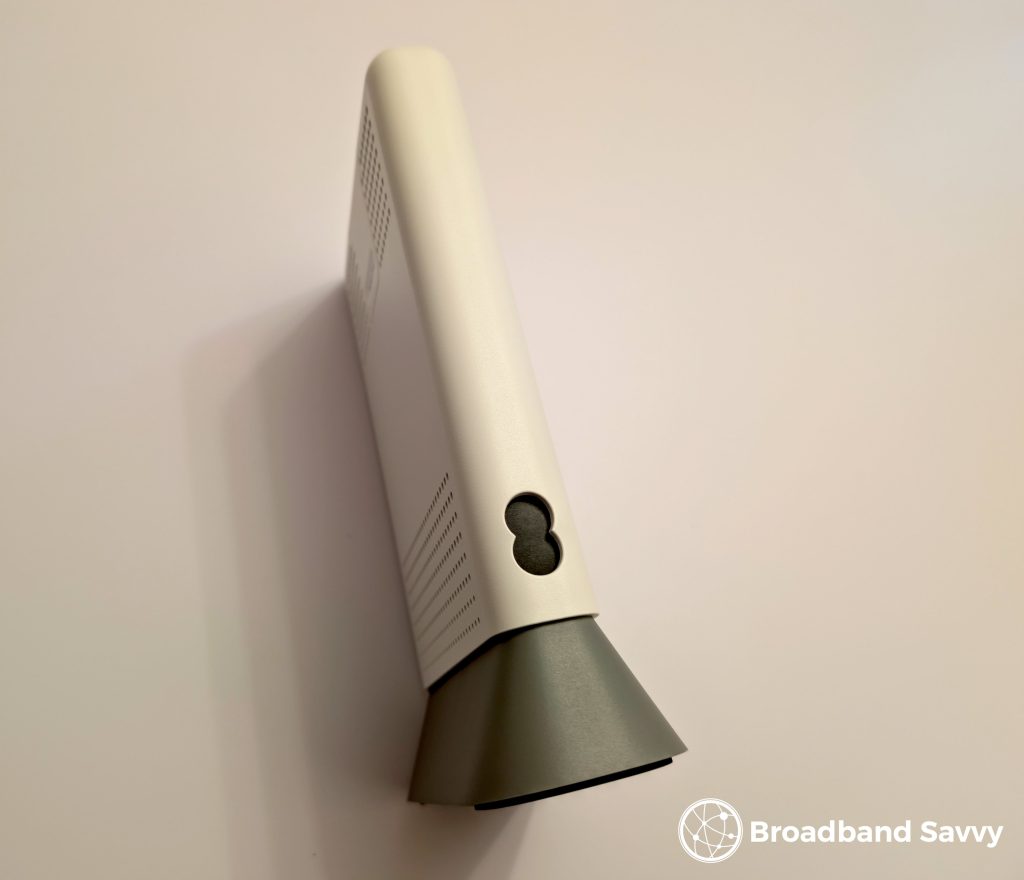
You can also bring your own router to use if needed most of the time, replacing the provided one with your own tech.
If you have a larger house and need a mesh WiFi system to get good signal, this is what we recommend doing. You can get mesh WiFi as an add-on with your broadband plan some of the time, but it can be very expensive.
Step #6: look for broadband and mobile discounts
Now that you have a shortlist of broadband providers you would consider joining, you might like to pay particular attention to those that reward you for bundling mobile services with them – especially if you already have a phone plan with a major network, or want to switch mobile providers.
The two main companies that do this are EE and Vodafone.
With EE, you get access to cheaper unlimited data SIMs as a broadband customer, and other discounts on mobile plans.
With Vodafone, you can get a discount on broadband if you’re an existing pay monthly mobile customer, and discounted mobile deals are also on offer for broadband customers.
BT Mobile also has phone deals that are only available for broadband customers, in case you’re looking for a new SIM.
Step #7: consider how the service will be installed
This is not a major issue in most cases, but is something you might like to consider.
If you’re switching to a new broadband network for the first time, they will need to install the last little piece of their connection from the street to your house.
Most of the time, they can use existing ducting, and the process is fairly straightforward. You’ll just need to be home on the installation day to let them inside.
This type of more involved installation is most likely to occur when switching to an altnet for the first time.
If you’d prefer to avoid a technician visit, you may be able to do this by staying on the same network, for example by switching between different Openreach providers, such as from BT to Sky.
However, if you’re upgrading to full fibre broadband for the first time, you will still need a technician visit even if you’re staying on the same infrastructure.
Step #8: assess providers’ customer service
To further refine your shortlist of broadband providers to choose from, we recommend eliminating those that don’t have the best customer service.
This can be a bit hard to gauge, especially because broadband providers’ service consistency and customer support can vary quite a lot over time.
The main thing we recommend doing is checking out Ofcom’s quarterly report on the number of customer complaints that each major provider is receiving.
This can be a really good way to gauge the relative performance of bigger broadband providers, though they have all been performing relatively well in recent years, especially compared to before 2020.
For smaller companies, you can check out their reviews on websites such as Trustpilot to gauge their customer satisfaction.
Step #9: find the best value for money deal
At this point, you should have a relatively small list of different broadband providers to choose from, and an idea of which of their deals you would most likely buy.
The thing to do now is see which plan is the best value for money.
Remember, most broadband deals now come with mid-contract price rises. So the headline price is not the amount you will be paying throughout the life of the deal.
You can use our contract cost calculator to get an idea of the total price of a given tariff, and how the monthly cost changes over time.
Related resources
5 Best Broadband And Anytime Calls Deals | Unlimited Data
Discover the UK's best unlimited broadband deals with anytime calls. We explain which providers offer unlimited broadband and calls.
Best 5G Home Broadband Deals UK | 5G Internet Plans
Discover the three best 5G home broadband deals in the UK in 2026. Find the best way to get online with 5G internet.

Best Broadband And Mobile Phone Deals | Top 3 Bundles | UK
Discover the 3 best broadband mobile phone deals in the UK. Bundle broadband with a pay monthly phone or SIM deal - and save...

Best Broadband For Rural Areas – UK | 4G, Satellite & More
Learn how you can improve your broadband speeds if you live in a rural area. We explain 5 methods to increase your download speeds.

Tom is the founder of Broadband Savvy. He has nearly 10 years’ experience writing broadband tutorials, reviewing routers and internet service providers, and explaining broadband-related concepts. Tom is experienced as a writer, has appeared on national radio and in national newspapers, and also produces videos for the Broadband Savvy YouTube channel.
He currently specialises in writing content for Broadband Savvy designed to help people understand broadband jargon and terminology, increase their download and upload speeds, and improve their Wi-Fi connectivity. Tom also occasionally contributes to buyer’s guides and review articles on Broadband Savvy, utilising his knowledge of the broadband market in the UK.
When he’s not writing about broadband, you’ll find him hiking somewhere or playing on his Nintendo Switch.