
If your broadband contract is up for renewal, you might be facing a significant price increase compared to what you’re currently paying.
When it comes time to enter into a new contract, most broadband providers charge existing customers a lot more than new customers.
But if you know how to negotiate, you can get a better deal and save potentially hundreds of pounds per year on your broadband bill.
Contents
Step #1: do your research
The most important step in haggling for a better broadband deal is to do your research.
The first thing to do is look at the renewal offers given by your current broadband provider.
Take a close look at these deals, and make note of:
- The monthly cost
- What speeds, add-ons, and other extras are included
- How each offer differs from your current broadband plan
Then, find out what other similar broadband deals are available at your address from other providers, and what prices are on offer.
The most effective way to get a better renewal offer is to convince your current provider’s customer retention team that you are planning on leaving.
We’ve explained in more detail how to do this later in the article, but the first step is to have two or three other providers’ deals on-hand, ideally with lower pricing than the renewal deals you are being offered (it should be fairly easy to find cheaper plans from other providers, because most renewal offers are quite expensive).
You can use our broadband deals guide or provider list to find other companies with similar deals on the market.
For example, say you are using BT Full Fibre 500, paying £32 per month during the contract period, and BT offers you a £35 renewal quote.
If you go to Vodafone Broadband, which is often one of the cheapest providers on the market, you might find that they offer a 500 Mbps broadband-only deal for £28 per month.
You can use this information later to help convince BT to offer a better deal.
Step #2: know which providers will negotiate
It’s important to know which broadband providers are more and less likely to negotiate, so that if you have a hard time haggling later on, you know whether to keep trying or not.
In general, the companies most likely to be flexible are the major providers that are known to have higher renewal prices compared to their in-contract pricing.
These companies include BT, Virgin Media, and EE. Sky will also negotiate sometimes as well.
On the other hand, providers such as TalkTalk and Plusnet normally offer renewal deals much closer to the new customer price, or are just a lot less likely to negotiate in general.
Vodafone does offer competitive renewal deals most of the time, but they can also be negotiated with.
When it comes to altnets, this can vary massively depending on the company you are with, but the majority of these providers are in the second camp.
Essentially, if you are facing a 15% or higher price increase on your new deal, the provider likely has room to negotiate. Below that, it becomes less likely.
Step #3: phone your provider
Now it’s time to contact your provider and begin negotiating a better deal.
In general, this needs to be done over the phone, and you need to reach the company’s customer retention team.
To do this, usually the most effective method is to say that you want to cancel your service, but then accept if they ask if it is OK to transfer you to someone to speak more about your deal.
You want to tell the retention team member that you have found a better deal with another provider, and likely plan on switching. Refer to the terms of the deal, especially its price, and mention how it is better value for money.
Be prepared for the retention agent to mention other functionality that you will miss out on if you switch to another company, such as WiFi tech, security/parental controls, or benefits for mobile customers.
The easiest way to counter this is usually to say that you don’t use these features, or are most concerned about keeping the cost down.
This should prompt the retention team member to begin lowering the pricing on the deals they are offering you, in order to keep you as a customer.
In an ideal world, you should be prepared to actually switch providers, because this will allow you to get your current company’s price as low as possible. You can simply pick whichever provider ends up offering the best value, given the slight hassle involved in switching.
Switching providers is often the best way to get the lowest possible price, and also allows you to update your WiFi router potentially.
If you would much prefer to stay with your current provider, this is completely fine, but you may not get their lowest possible price.
If this fails, and you are with a company such as Virgin Media that has room to negotiate, try to call back the next day. Speaking to a different retention agent can sometimes help you get different results when negotiating.
Step #4: switch providers temporarily (optional)
This is an extra step you can take if you are not satisfied with the final renewal offer you were able to get over the phone.
If you place a new broadband order with a different company, your current provider will be automatically notified of your intention to cancel.
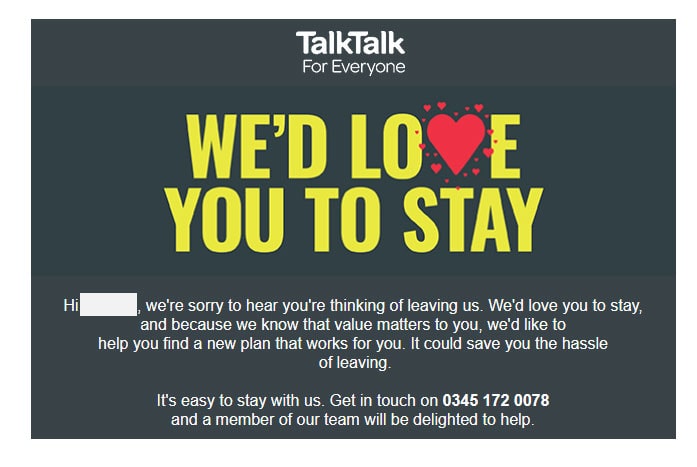
At this point, they will often email you a last-ditch renewal offer to encourage you to stay with them, or at the very least give you a direct number to their retention team. This is often the way to get the absolute best possible renewal price.
Remember, broadband contracts in the UK have a 14-day cooling-off period, so you can cancel the new order if you end up getting a better deal from your current company.
The best time to use this strategy is when you are indifferent about staying or leaving, then you can choose whichever provider ends up being the best value.
But thanks to the statutory cooling-off period, you can also do this if you intend to stay with your current broadband provider as well.
Related resources

How To Switch Broadband Provider | 3 Steps Explained | UK
Learn how to switch broadband provider. We explain the process of changing to a different broadband provider from start to finish.
How To Get Fast Broadband When Renting
Learn what you can do as a renter to get fast broadband at home, when struggling to get permission to have fibre installed.
Broadband Altnets Explained – Should You Buy From One?
Learn everything you need to know about broadband altnets in the UK, including whether or not you should buy from one.

Tyler is the co-founder of Broadband Savvy. He has been helping people improve their broadband connectivity since 2018 by writing about fibre broadband and mobile broadband providers, as well as creating tutorials to help people improve their broadband speeds and Wi-Fi signal.
Tyler is responsible for the majority of buyer’s guides and broadband reviews published on Broadband Savvy. He has a wealth of experience testing and reviewing different broadband tariffs, including fibre internet plans, as well as 4G and 5G broadband deals. He is responsible for testing and evaluating Wi-Fi routers, performing speed and latency tests, and comparing the value for money of different broadband providers on the market in the UK.
Before co-founding Broadband Savvy, Tyler had a long history of tinkering with computers. He built his first PC at the age of 12, and since then, he’s become obsessed with all things networking and internet-related. He’s a massive gamer, loves Rocket League, and also plays Sunday League football.